I made a website called kam.fm.
On it is a comedy album called Strategic Relationships by Rich Brooks & The Stakeholders (aka me). Ten tracks, ten random genres: UK garage, gangsta rap, a power ballad, indie, Eurovision, country, heavy metal, drum and bass, a Disney ballad and the closing number from a musical that does not even exist. Every song is about the busy life of a key account manager.
Songs, artwork and the streaming site took about five hours. I used Suno, Claude, Claude Code and Grok. The tracks are rough on purpose because I wanted to use the first pass of everything. Listen closely and you will hear the mistakes. These songs don’t do Suno justice as it has plenty of tools for polishing a track into something that sounds much more professional, and I used none of them (if you had more time you could).
The point was to show a room of senior salespeople two things: that AI can be creative, and that anyone in that room could build something like this in an afternoon for less than the cost of a couple of CDs.
The Key Account Management Blues
It started as a joke. In 2024 we sent Javier Marcos off to a conference in Finland to present his latest research on AI and B2B sales, and it seemed a shame to let him go with only slides. So I used an AI music tool to write him a song: “The Key Account Management Blues”, a twelve-bar lament from a guy pulled in every direction at once. Bob from marketing is always on his case, the targets keep rising, the pressure never ends, and every morning he laces up his shoes and goes back for more. He played it to a room full of academics and they seemed to like it.
Here it is on YouTube. I’m hoping to get over 100 hits before the end of the year so please like, share and subscribe.
Watch on YouTube if the player does not load.
That was supposed to be the end of it. Instead I started closing my own workshops with the song, in place of the summary slide (nice to have some background music). I expected a polite laugh but what I got was a room of salespeople singing the chorus back at me, and then, more usefully, some of them asking how I had made it.
So we did more of it. And somewhere in there came the daft question: could we, in our wildest dreams, make a whole album? Not just the songs. The whole thing, with a Spotify-style player to deliver it, so it looked and felt like a real release rather than ten MP3s in a folder.
There is no instruction book
The barrier to adoption is not capability. Access is a barrier for some, because plenty of company IT teams still ban Claude and ChatGPT on the work laptop, but everyone in the room has one of them (and half a dozen alternatives) on the phone in their pocket. So access explains the people who can’t. It does not explain the people who can and don’t.
Those people are busy. Senior people, the ones who run big accounts and big teams, have used ChatGPT to tidy up an email or shorten a report, it did the job, and they got on with their day. The trouble is that this technology moves very fast. What it could not do in January it does in June, and nobody has the time to sit down and keep up. So they wait for someone to hand them the instructions.
And there aren’t any. Playing is how you find out. This is new technology. There is no instruction book, no best practice, no course that tells you what it can do, because nobody knows yet. It is the frontier. The only way to find out what is possible is to pick it up and play with it, most of which will not work, until something does.
That should suit us. Key account managers and entrepreneurs are born to be creative. We spend our working lives one inch deep and five miles wide, looking across a customer’s whole world and joining things up that nobody else has joined. We found that this is exactly what this technology is good at. It will go deep in any direction you point it, and it never gets bored. Put it in the hands of creative people who are motivated to solve a real problem and you get ideas and methods none of us had thought of. That is the bit the crowd who only use it to write LinkedIn posts never see.
How it was made
The words came first and were from me and Claude (I like how it writes). I would describe a genre and a situation, “UK garage, the first morning of the quarter, the forecast is already wrong”, and we would go back and forth until the lyric had the right number of things a salesperson would recognise. The test for every line was whether someone in my workshops would smile. “My love language is revenue, my safe word is margin” is one of my favourites.
The music came next and was made by Suno, which turns a lyric and a style description into a finished track with vocals. Ten dollars a month. I took the first version of every song, mistakes and all, which is why the Eurovision entry sounds like it came last.
The artwork came from Grok, one cover and one image per track, gold and black, a handshake with music notes.
Then the bit I was least sure about: the player. I wanted it to look like Spotify, because a folder of MP3s is a demo and an album with artwork and a play button is a release. I opened Claude Code and described it: per-track artwork, a colour for each genre, lyrics that scroll in time with the music, a visualiser bouncing along underneath, and the tracks playing straight through like a real album. It wrote the lot. The only manual job was timing the lyrics, so I had it build a second little tool where you tap the spacebar as each line is sung and it spits out the timestamps. The whole thing went on Netlify. Later I put it on its own domain, because kam.fm was available and I could not leave that alone.
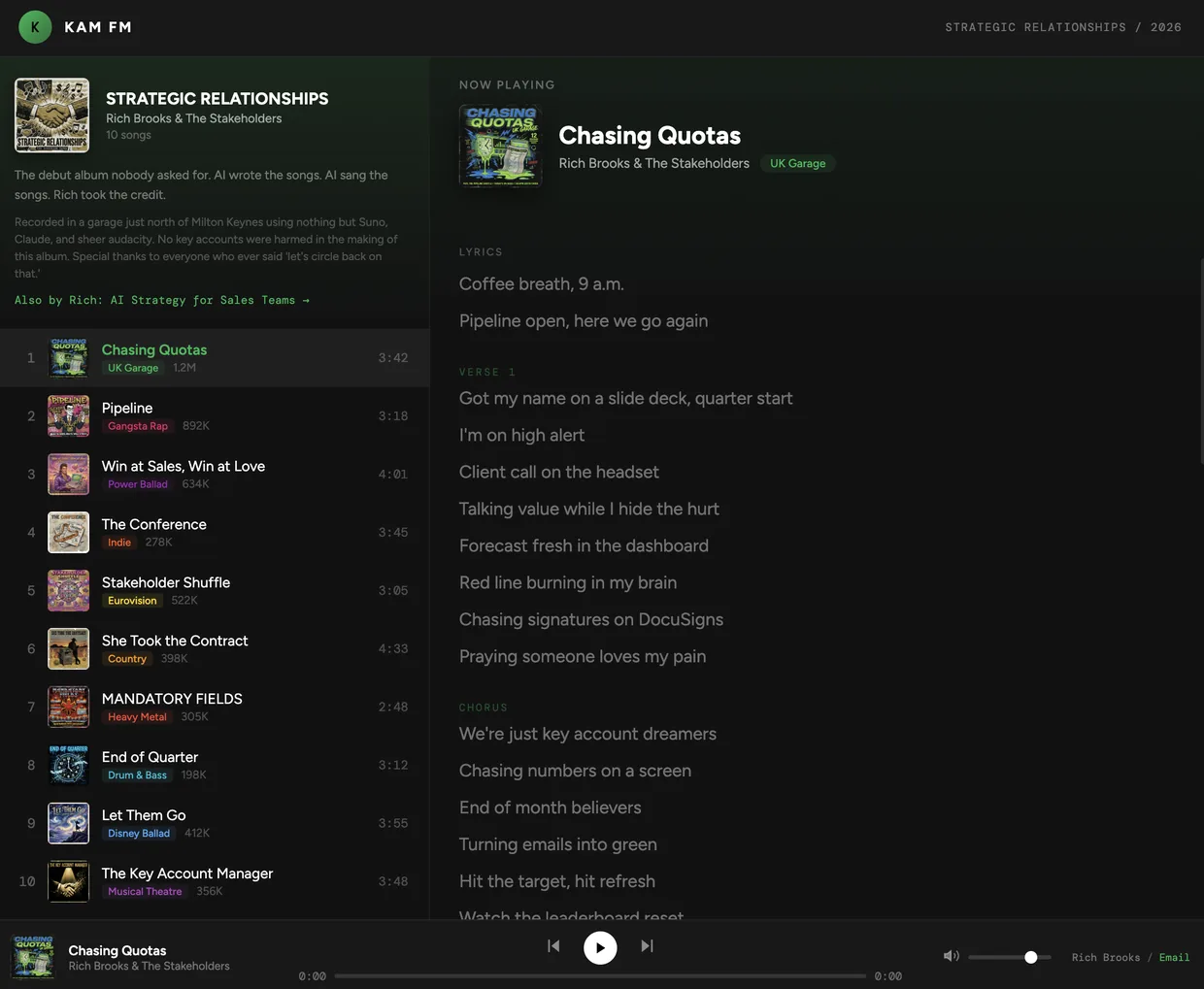
Total time was five hours from the first lyric to the live site. Around thirty dollars in various AI credits. No skill I did not have at the start of the day, other than the willingness to look slightly ridiculous.
The songs are jokes about the job. “Pipeline” is a rapper boasting about his BANT qualification. “The Conference” is an indie song about a lanyard, a keynote on synergy and a hotel function room in Coventry. “Mandatory Fields” is heavy metal about the CRM. “Let Them Go” is a Disney ballad about the account you should have walked away from. Anyone who has done the job will hear their own week in it. There is no lesson hidden in the lyrics.
The lesson is in the making. Someone who has spent two days on account plans and stakeholder maps watches a man of my age play a drum and bass track about end-of-quarter panic and thinks: he made that. With the tools I have. If he can do that, I can do the thing I actually need, which is smaller and more sensible. It lowers the bar to the floor and then invites you to step over it.
So go and listen. It is at kam.fm. Then make something daft of your own.